Microtonal Ghosts

I’m boldly creating a thread for anyone making music with the synths of Kinotone pedals, particularly Ghosts, but not exclusively.

As a sort of PSA, if you have a Ghosts and a midi keyboard, you absolutely should experiment with the “user” scales and making your own for using it as a synth. I finally bought a Keystep 37 and figured out how to load the user scales.

I’d been getting deep into just intonation, and I find microtonality to be one of Ghosts’ superpowers. Are there any other hardware physical modeling synths that allow for customizable microtone scales? Probably something like Iridium, but not in a guitar-pedal-sized object that isn’t $1000+.

I absolutely hope for key velocity in the next firmware and would love expanded control of the air mode for longer attack times, and other harebrained wishes, but, as is, y’all need to mess with this mode.

Try out the hyperconcord scale: it’s gonna blow your mind. I’m not a keyboard player, but a beautiful scale hides my ignorance. Regardless, please, all you Ghosts users, don’t let this mode go unexplored.

One last tip for synth playing: turn the tone all the way down, or start with tone very low. It makes for a very tasty sine wave generator and the tone can be brought up for emphasis.
4 Likes

That’s brilliant! As I reading this, a thought occurred to me. It would be really cool to tune s synth to Just or Meantone Temperament and if you want to play a song in a different key, set the key and the synth will retune for the temperament in that key.

And if you a wolf tone, it can adjust the frequency in real time to minimize the the Pythagorean Coma. That does mean that one, maybe both of the keys in the wolf tone will play two different notes depending on other notes in the melody or harmony. That might be too much. Might be better to still avoid wolf tone.

I just got a Ghosts.
I was (perhaps naively) thinking that I could load a microtonal scale and then the CHORD and ROOT knobs would adhere to that scale, and that anything I run through the pedal I would be able to apply the resonator at those microtonal frequencies. But it looks like it just lets you play the pedal as if it was a synth, albeit a microtuned one.
I mean I already have a microtuning capable synth (Korg Monologue) so it’s not massively appealing like this.

You can easily define your own custom resonator chords using MIDI and “apply the resonator at those microtonal frequencies” exactly as you suggested. You just have to set the chord to USER and set the EXCITER TYPE to “vocoder hold”.

You can read all about it in the manual.

Using the CHORD knob to set different chord structures in a microtuned system wouldn’t make any sense. In many microtonal systems, terms like major 9, minor 11, perfect fifth, etc have no meaning.

1 Like

There are ways that I almost wish that CHORD and POSITION knobs interacted with the midi keyboard too. For instance, I love to use the octave CHORD position with the contact mic to do single note lead lines, but the ROOT knob is too fiddly to find the right note without hitting an accidental or two in the process. Thus, I think a sort of monophonic octave mode would be cool where you can determine the root with a midi keyboard.

But, yea, it doesn’t make sense from the hardware perspective to have those knobs function the same way for custom scales.

Can’t have your neutral thirds and eat them too.

If you use vocoder hold on the Hyperconcord or 7-limit JI scales and mash random inversions, I think you’ll find interesting chords for the resonator.

Quick question for Jaak: what is the hypercondord scale? Seems like there are two micro intervals but otherwise a pretty normal sounding scale.

Your interest in this has made me realize there was a small mistake in our online manual. The scale names used in the 2nd and 3rd presets were switched. So the scale you are enjoying is actually the 29th harmonic rainbow. I just updated this.

Here is some more info about the user scale / chord presets:

1. Init

  • Tuning: Equal temperament
  • Chord: Herbie Hancock minor 9 voicing

2. Dark shifter

3. String Loops

4. Glitter Physics

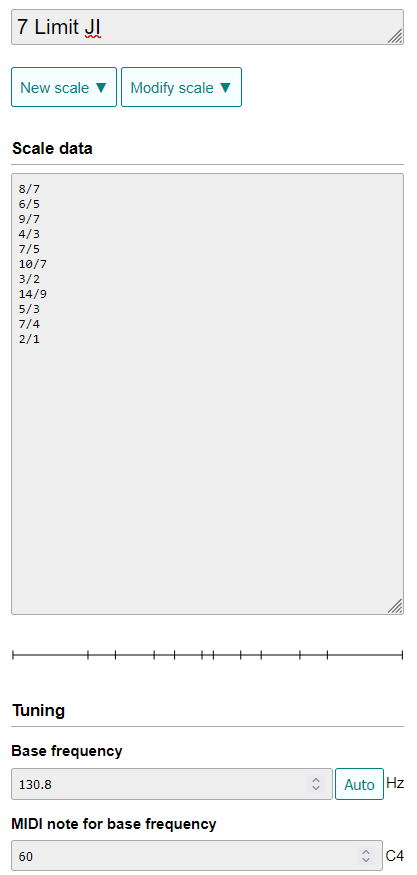
  • Tuning: 7 limit JI
  • Chord: Not sure what to call this chord - discovered it by ear
  • Scale workshop screenshot:

5. Harmonic Pulse

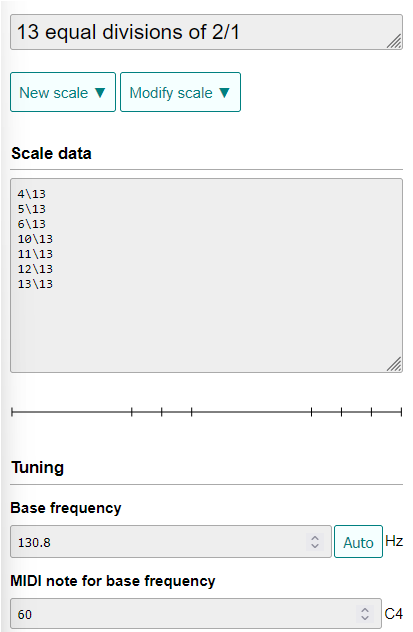
  • Tuning: 13 EDO Subset - inspired by an Aphex Twin microtonal scale
  • Chord: Not sure what to call this chord - discovered it by ear
  • Scale workshop screenshot:

6. Sparkle Shifter

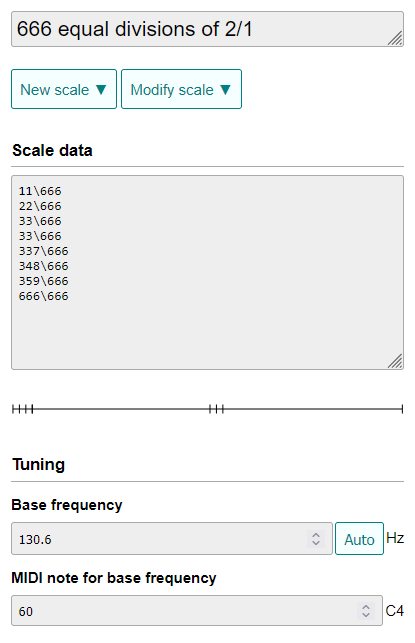
  • Tuning: 666 EDO Subset - inspired by an Aphex Twin microtonal scale
  • Chord: Not sure what to call this chord - discovered it by ear
  • Scale workshop screenshot:
4 Likes

Yeah, I agree there’s some really exciting potential in deeper MIDI interaction between CHORD, ROOT, and VOICING, but it comes with a few tricky edge cases. We talked about some of this here.

For example, if we made ROOT do transposition and VOICING do inversion on incoming MIDI notes, a beginner could plug in a keyboard and immediately get “wrong” notes (everything shifted or inverted) without understanding why. Also, ROOT is currently as a quick way to switch between “MIDI Note Takeover” and normal front panel control, so repurposing it would mean we’d need a new way to handle that mode switch.

I’m with you on that. A monophonic chord mode where the keyboard sets the root would be useful. I’ll add it to our list of things to consider for a future firmware update.

3 Likes

Awesome, thank you! I’d been looking into Amelia Huff’s work but couldn’t square the scale of preset 3 with the short video she made about it. But this makes sense!

Thanks also for your thoughts about the monophonic mode: I think it would be cool. I’ve been listening to the karplus strong sounds of Kali Malone’s new album Magnetism and want to achieve some of the boldness of really big karplus plucks. The octave mode and its subtle detuning gets pretty rich.

1 Like

Does anyone have any recommendations for Ipad apps to use with microtonal scales for connection with Ghosts? I tried Synth One (using Colundi scale) but I couldn’t get it to work. I’m not even sure it’s outputting MIDI as all the MIDI options seem to be about input.

I’m not familiar with Synth One but you can create Colundi scales in Scale Workshop and then export the MTS Sysex Bulk Tuning Dump file that Ghosts expects. Then send this to Ghosts using Sysex Librarian or Midi-OX.

1 Like